Georgina
SCOTTISH ROMANCE: My Sinful Surrender to a Highlander Werewolf (Scottish Werewolf Pregnancy Romance) (Historical Medieval Shape Shifter Paranormal Science Fiction Short Stories)Georgina is Nicholas’s wife, presented first through a public image of marital success and then through the private terror that image conceals. Her significance lies in that reversal: the apparently settled woman admired as proof that happiness is possible is also a woman frightened by her husband’s volatility, injured by his coercive behavior, and eventually prepared to leave him. Through Georgina, the narrative exposes the distance between a socially legible marriage and the lived reality inside it.
Identity and Introduction
Georgina enters the story during a weekend away with Nicholas and Kerrigan. Nicholas describes her as his wife, and Kerrigan sees their married profile picture, with their hands held together, as charming and faintly amusing. The first impression is therefore carefully domestic: Nicholas has served his country, survived his own darkness, and apparently found a lovely partner with whom to settle. Georgina’s presence seems to confirm the hopeful idea that even a damaged man can build a satisfying life.
When Nicholas introduces her directly, Georgina responds to Kerrigan in a kind, controlled, congenial voice and says that Nicholas has told her a great deal about him. Her measured politeness gives her a composed public persona, but the restraint also becomes retrospectively revealing. She is not introduced through open conflict or visible rebellion; she is introduced as the socially acceptable wife who knows how to behave in company while carrying circumstances that she cannot safely disclose in front of her husband.
Marriage and Hidden Fear
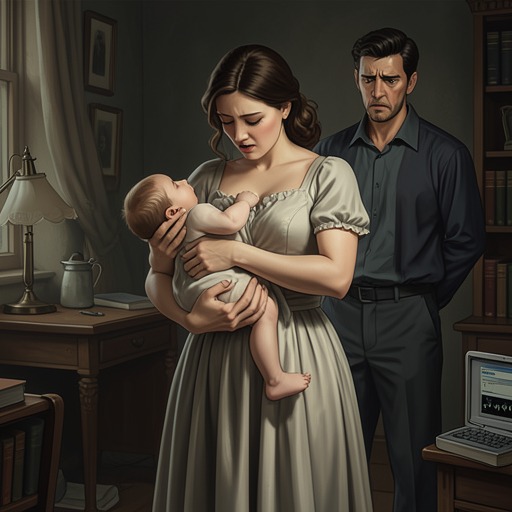
The marriage’s public appearance collapses when Georgina tells Kerrigan that she is afraid of Nicholas. She describes a man who can be happy one moment and drunk and insane the next, and she fears that his threats to kill anyone who interferes may be genuine. Nicholas’s status as an army veteran intensifies that fear in her account, not because it automatically makes him violent, but because his capacity for violence is part of the danger she believes she must manage.
Georgina’s account becomes concrete when she says that Nicholas hurt her. She clarifies that he did not hit her; instead, he twisted her wrist and ordered her to repeat the phrase “Honey please.” The distinction matters because it shows how abuse can operate through restraint, humiliation, and intimidation without leaving the most immediately recognizable mark of a beating. Her tears and flinching communicate that the injury is both physical and psychological. The command turns an ordinary term of affection into an instrument of submission, making language itself part of the coercion.
Her dilemma is not simply whether the marriage remains loving. She asks whether Kerrigan should help her retract Nicholas’s drunken declaration that they are no longer in love and pretend that the marriage is intact. The possibility of lying is weighed against the danger of provoking Nicholas. Georgina is thus caught between maintaining the public fiction of marital stability and admitting the private truth that the relationship has become unsafe. Her fear gives the marriage an exit cost far greater than the apparent simplicity of saying that it is over.
Georgina and Kerrigan
Georgina’s conversation with Kerrigan turns him from an observer of Nicholas’s marriage into the person she trusts with its hidden reality. Kerrigan initially responds with bravado, saying that Nicholas could not kill him, but Georgina’s disclosure makes clear that the central issue is not whether Kerrigan can defeat Nicholas. It is whether Georgina can live without being controlled by him. Kerrigan’s role begins as confidant and protector before it becomes emotionally and sexually complicated.
The relationship develops through a mixture of consolation, attraction, and uncertainty. Kerrigan puts his arms around Georgina to calm her racing heart, and she struggles against an attraction that becomes increasingly difficult to suppress. She touches his stomach, chest, shoulder, and neck, while he responds by drawing his body closer. Georgina then tells him, “I want you,” and qualifies the confession by saying that she does not know about tomorrow but wants him now. Her words make desire an immediate, self-conscious claim rather than a settled promise of a future relationship.
That scene does not erase the conditions under which the attraction arises. Georgina has just described coercion, fear, and injury, and Kerrigan’s strength is part of what attracts her even as strength has been used against her in her marriage. The narrative therefore places rescue and desire in close proximity without making them identical. Georgina seeks comfort and recognizes her own longing, but her uncertainty about tomorrow preserves the difference between a moment of safety and a guaranteed new life.
Separation and Consequences
The decisive change in Georgina’s arc comes when she acknowledges that she is leaving Nicholas. When asked directly whether she is leaving him, she answers yes and says that she thinks it is time. Kerrigan agrees, even while admitting that the conclusion hurts him as Nicholas’s friend. Georgina’s decision is consequently represented as both personal liberation and a rupture in an existing social bond. Leaving requires her to reject not only Nicholas’s private control but also the public identity of being his wife and the loyalty expected by his friends.
Her departure is not presented as a neat emotional reset. Georgina has moved from a controlled public performance to a dangerous admission, from fear to reliance on Kerrigan, and from reliance to the difficult act of ending the marriage. She has also become pregnant through her connection with Kerrigan, an accidental child that complicates every decision about freedom, intimacy, and the future. The pregnancy means that leaving Nicholas is not merely an individual escape; it creates a new family reality whose consequences must be negotiated by Georgina and Kerrigan.
Narrative and Thematic Role
Georgina’s storyline places marital intimacy inside a wider pattern of arrangements shaped by money, status, dependency, and restricted choices. Elsewhere, marriage is explicitly treated as a business deal: Abigail plans to marry a rich American, divorce him, and use the money to start a business; William considers a mail-order bride as a contractual solution to an inheritance condition; Jenna enters an open-marriage arrangement because divorce seems worse than permitting her husband to have a boyfriend; and Dennis offers Kember one hundred thousand dollars, medical expenses, and possible employment in exchange for surrogacy. Georgina’s marriage is not described in those contractual terms, but her experience shows the darker side of a relationship that has become an unequal arrangement of authority and obedience.
Her experience also complicates the idealized image of Nicholas’s recovery. Kerrigan sees Nicholas’s marriage as evidence that someone who might otherwise be consumed by darkness can find happiness. Georgina’s testimony reveals that the same marriage can appear inspirational from outside while being frightening from within. The contrast is central to her narrative function: she prevents the reader from treating domestic settlement, a wedding photograph, or a husband’s public reputation as proof of safety.
Georgina is given a voice at the moment when the official story of her marriage fails. She names her fear, identifies the act that injured her, admits her attraction to Kerrigan, and makes the decision to leave. Her arc therefore moves from being seen as Nicholas’s lovely wife to speaking as an individual whose body, desire, and future cannot be contained by that title. The ending supplied for her story leaves her in transition, but the transition is decisive: she chooses separation from an abusive husband and begins constructing a different life through her bond with Kerrigan and their unborn child.